Free Film Screenings for Students from grade 7:
Starting in January 2025, we offer schools across Germany the opportunity to screen selected films either at you school or in a cinema of your choice.
Experience Human Rights
Through captivating documentaries, you can provide your students with insights into international human rights issues. Following the screening, there is an option to arrange discussions with filmmakers and experts to encourage deeper engagement and meaningful conversations.
How it works:
- Choose a Film: The films presented here are specifically selected for students from grade 7 onward, designed to make complex topics easy to understand while encouraging deeper engagement.
- Select Date and Venue: You can screen the films on a date of your choice, either at your school or, in coordination with us, at a cinema of your choosing. The films are available in their original language with English subtitles or with German subtitles.
- Request a Q&A Session: For groups of approximately 100 students or more, there is an option to invite filmmakers or protagonists to participate in the screenings.
Request a Screening here
Films
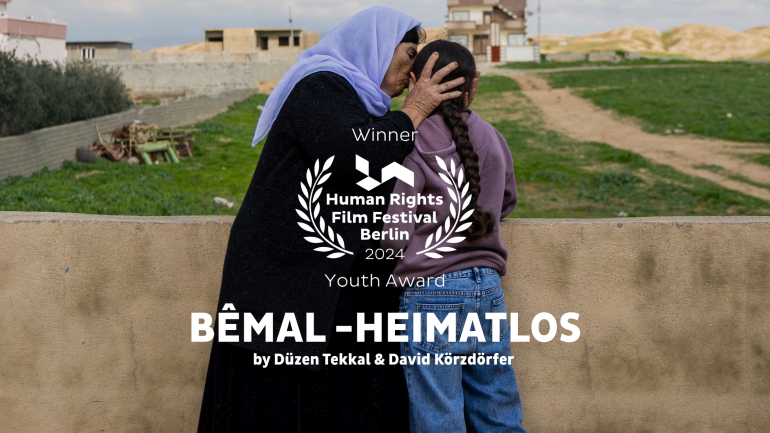
Bêmal – Heimatlos (Winner Youth Award 2024)
Düzen Tekkal, David Körzdörfer | 86 min | GER | 2024
Language: German
Topics: Conflict and Peace, Feminism, Refugee Rights
Subjects: Politics, Ethics, History
Recommended for students from Grade 7
August marked the tenth anniversary of the genocide committed by the so-called ‘Islamic State’ against the Yazidis. Thousands of Yazidis were systematically killed, enslaved and displaced. Since then, the religious minority has been struggling with the consequences of the terror. Four sibling pairs tell their stories before the camera of activist and documentary film-maker Düzen Tekkal from HÁWAR.help. Together with co-director David Körzdörfer, Tekkal accompanies the protagonists through their lives in Germany and Iraq. Talking with Annalena Baerbock, Tekkal emphasises the measures needed today to protect the Yazidis, including the actions required from the German side.
Die Möllner Briefe
Martina Priessner | 96 min | GER | 2025
Language: German/Turkish, with German subtitles
Topics: Racism, culture of remembrance, social exclusion, solidarity, civil society, representation, trauma, empowerment, self-efficacy, and activism
Subjects: Politics, History, Ethics
Recommended for students from Grade 8 (ages 13 and up)
The film tells the stories of the victims and survivors of the racist arson attacks in Mölln in November 1992. Seven-year-old İbrahim Arslan survived with severe injuries and lost his sister, cousin, and grandmother. For decades, the perspectives of those affected went unheard in public remembrance. In 2016, thousands of letters addressed to the families were discovered in the Mölln city archive—written as expressions of solidarity—but never delivered. The film follows İbrahim Arslan on his journey through this long-neglected archive: he reads the letters, meets their authors, confronts the city archive about withholding them, and engages with his own history. What emerges is a multifaceted reflection on remembrance, loss, structural silence, and the power of solidarity. Suppressed voices move to the forefront: the unheard stories of those affected form the heart of the film, illuminating the personal and political dimensions of memory, trauma, and solidarity.
The films are available to cinemas for school and educational screenings free of charge until the summer holidays of 2025. Thanks to the participants of the German Postcode Lottery, the film rights are covered, meaning no screening fees apply.
The school film program is presented as part of "Stories for Change" – an initiative by the Human Rights Film Festival Berlin and Schools Against Hunger that takes young people on an inspiring journey. Made possible by the participants of the German Postcode Lottery, this initiative combines interactive lectures, multimedia educational materials, and a tailored film program to broaden students’ horizons, foster empathy, and inspire solidarity for a fairer world. This participatory approach raises awareness, encourages reflection, and mobilizes young people to take responsibility for our global community. With "Stories for Change," we are investing in the changemakers of tomorrow, contributing to the fight against climate change and global inequality.